Some of the best-known stories about European dishes are folklore. Marco Polo did not bring pasta back from China. Paella started as a farm workers’ lunch. The stories are better than that, and they are usually about trade, poverty, or someone making do with what the boat brought in.
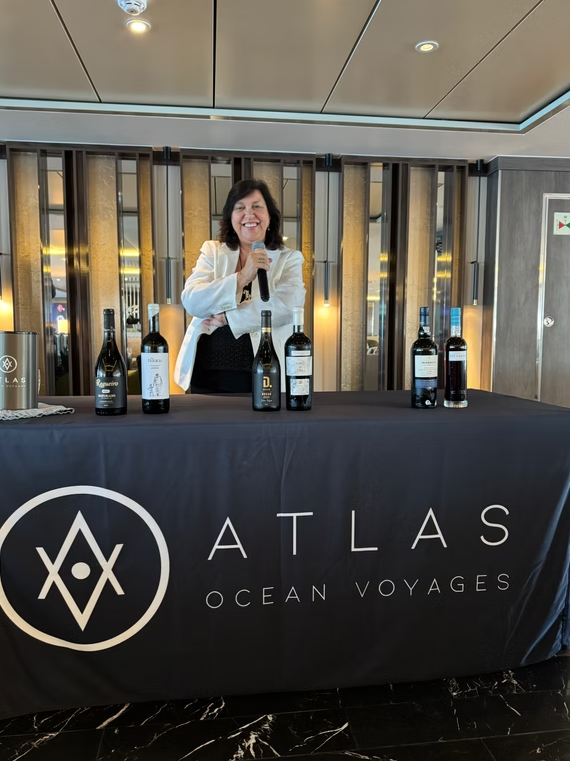
That is the territory Master Foodie™ Mara Papatheodorou works in. She is a culinary specialist and historian who draws out the stories and connections of cuisine and culture through facts, flavors, flair, and folklore. This is a useful way to put it, because the four are tangled together in almost every famous dish.1
Who Is Master Foodie™ Mara Papatheodorou?
Mara Papatheodorou is the Tastes & Traditions Expert for Atlas Ocean Voyages and a nationally established entertaining specialist. She spent 12 years as an editor at Bon Appétit, where she scouted and produced the “Entertaining with Style” section, covering how people actually entertain around the world. She also produced the magazine’s award-winning annual international Special Collector’s Editions, which covered Italy, France, Greece, Spain, the Mediterranean Islands and the British Isles.
That list is more or less a map of European cuisine as most travelers meet it, and of the dishes below. It is also a reasonable itinerary.
The History of Dried Pasta Starts in Sicily, Not China
The Marco Polo story is the most repeated claim in European food history, and the evidence points elsewhere. It appears to come from a misreading of a passage in his account, where he describes a tree producing something resembling pasta, probably the sago palm.
The documentary record runs earlier. Dried string pasta appears in Arabic sources as itriyya, and in 1154 the geographer Muhammad al-Idrisi, writing for King Roger II of Sicily, recorded that it was being manufactured in quantity in the Sicilian countryside and exported to Calabria and beyond.2 That is roughly a century before Polo traveled at all.
So the history of dried pasta is a Sicilian and Arab story before it is a Venetian one. Durum wheat, a hot, dry climate suited to drying dough, and a trade network to move it. Atlas calls at Italian ports from Naples to Livorno to Venice, and the further south the itinerary runs, the closer it gets to where this began.
Paella Began With Farm Workers in Valencia’s Rice Fields
Paella starts with rice, and rice in Valencia goes back more than 1,000 years. The Moors first grew it in the Albufera wetlands south of the city in the eighth century.³ The dish itself is harder to date. One likely account credits Albufera rice farmers in the 15th century, who gathered in the paddies to cook a substantial one-pot meal from what the surrounding fields offered: rice, snails, green beans, and waterfowl, cooked over a fire of orange wood.³
The wide, round pan gave the dish its name, and the meal became a reason to gather as much as a reason to eat. Today, a Valencian paella typically means rabbit, chicken, and vegetables, with the local beans changing by season.³
Bouillabaisse Began as the Fish Nobody Would Buy
Bouillabaisse now commands a high price in Provence, though it began as a way to use the fish the market would not take. Marseille fishermen built it from rockfish that were too bony, too small, or too ugly to sell, simmered with whatever aromatics were around. Atlas calls at Nice and Monte Carlo along the same coast, east of Marseille, where the dish began.
Greek Cooking and the Long Memory of Moussaka
Greek cooking carries layers from everyone who passed through. Moussaka is the clearest example. Eggplant arrived from the east; the name itself traces back through Arabic, and the creamy topping most people now consider essential is a comparatively recent French-influenced addition rather than an ancient one.
A plate of moussaka in Athens holds several centuries of contact, which fits Mara’s focus on the connections between cuisine and culture.
Tasting European Cuisine in the Ports That Made It
Food history reads differently standing in the market it came from. That is the argument for culinary travel over a cookbook, and it is what an Epicurean Expedition is built around: market tours, cooking demonstrations, and wine tastings led by guest chefs and vintners, plus the Yachtsman Cookoff, a friendly timed contest where guests cook and their fellow travelers pick the winner.
Shore excursions reach the specific rather than the general, from truffle hunting in the Tuscan countryside out of Livorno to a dinner inside the Valley of the Temples at Porto Empedocle. On a yacht carrying fewer than 200 guests, excursions run in small groups, so a market visit leaves room to stop, taste, and talk with the people behind the stalls.
Sailing With Mara in 2027
11-Night Athens to Nice
Mara hosts three voyages in 2027. The summer sailing traces the Greek and Italian stories above and ends on the same coast as the bouillabaisse. The 11-night Athens to Nice voyage aboard World Traveller, departing July 8, 2027, sails from Piraeus to Hydra, transits the Corinth Canal on the way to Itea for Delphi, then calls at Nydri and Zakynthos before crossing to Lipari in the Aeolian Islands, Capri, Sorrento, Civitavecchia for Rome, and Porto Venere for the Cinque Terre, ending in Nice. Greek cooking, then Italian, then the French coast, in that sequence.
10-Night Las Palmas to Seville Voyage
Her two spring sailings work the Atlantic side of the same map. The 10-night Las Palmas to Seville voyage aboard World Voyager, departing April 6, 2027, threads the Canary Islands, follows the Moroccan coast from Agadir and Safi to an overnight in Casablanca, then calls at Puerto Banús and Tangier on either side of the Strait of Gibraltar before an overnight in Seville. A second World Voyager sailing leaves Seville on April 16, 2027, for nine nights, ending in Casablanca. Both sail the Atlantic coasts of Spain and Morocco.
Taste the Stories Where They Started: Plan Your Luxury Cruise Now
Famous European dishes are easier to understand in the ports that produced them, where the geography explains the recipe. Explore Atlas’ Epicurean Expeditions through the Mediterranean and Asia, see the onboard experience, or browse itineraries.
Speak with our team to start planning.
Frequently Asked Questions
Did Marco Polo bring pasta to Italy?
Probably not. The claim appears to stem from a misreading of his account. Dried pasta was recorded in Sicily by the geographer al-Idrisi in 1154, around a century before Polo traveled, and the technique reached Sicily through Arab trade as itriyya.2
What are the most famous European dishes to try by region?
European cuisine varies sharply by region. Italy is pasta in its regional forms, Spain is paella and tapas, France ranges from Provençal seafood stews to the wine-country cooking of Bordeaux, and Greece covers moussaka and the island cooking of the Aegean. Which ones travelers encounter depends on where our luxury cruise calls.
Where does paella come from?
Paella is generally traced to the Albufera wetlands south of Valencia, where the Moors first grew rice in the eighth century. One likely theory credits local rice farmers in the 15th century, who cooked it in the fields with what was at hand, including snails and green beans.³ Today, a Valencian paella typically includes rabbit, chicken, and seasonal vegetables.
Why is bouillabaisse considered a luxury dish now?
It started as a Marseille fishermen’s stew made from rockfish that could not be sold at market. Scarcity reversed the economics: the small Mediterranean rockfish that made the original are no longer cheap or plentiful, and the labor involved is considerable, so a dish built from leftovers became an expensive one.
What does a Master Foodie do on board?
Mara Papatheodorou sails as a Tastes & Traditions Expert, connecting dishes to the places and people that produced them. Epicurean Expeditions also carry guest chefs and vintners who lead cooking demonstrations, market tours, wine tastings, and the Yachtsman Cookoff.
References
- Master Foodie™ Mara Papatheodorou, Tastes & Traditions Expert, https://www.marapapa.com/about
- Timothy Santonastaso, “A Brief History of Pasta,” Italics Magazine, May 29, 2020, https://italicsmag.com/2020/05/29/a-brief-history-of-pasta/.
- Jessica Vincent, “From Grain to Plate: The Story of Valencian Paella and Its Homegrown, World-Class Rice,” National Geographic, last modified April 11, 2023, https://www.nationalgeographic.com/travel/article/paid-content-valencian-paella.