Most voyages hand you a schedule. A polar expedition hands you a plan that ice, wind, and wildlife are free to rewrite before breakfast.
Someone has to make that call. On a yacht carrying fewer than 200 guests, that someone is the expedition leader, and you are close enough to watch them work.
The Job Starts Before You Wake Up
A polar expedition day begins with information the itinerary cannot contain. Overnight ice conditions. Wind direction at the intended landing site. Whether the swell will let a Zodiac come alongside safely. Whether wildlife has settled somewhere that makes a planned approach inappropriate.
The expedition leader gathers that picture, talks it through with the captain and the bridge, and decides. Sometimes the answer is the plan you were told about last night. Often it is somewhere else entirely, and the reason you end up in a better place than the one on the printed schedule is that a person made a judgment call at six in the morning.
It is rarely one decision. It is the landing site, the route in through the ice, how many guests go ashore at once, which specialists go with them, and the point at which the whole thing gets called off. Each is revisited as the morning develops, and one person holds all of them. That is why the schedule handed to you the night before is a starting point rather than a promise.
The job does not end once the Zodiacs are in the water. The leader spends the day watching the weather turn, moving groups between sites, and deciding when a landing that is going well should end anyway. The next day’s briefing gets written knowing it may not survive the night.
Ekaterina Uryupova, Expedition Leader aboard World Traveller™, put the rhythm of it plainly to Recommend magazine: “Every day is a new page, and visitors will write their own book of Antarctica.”1
Reading the Ice, the Weather, and the Water
Redirecting a day is not guesswork. It draws on years of pattern recognition in an environment where conditions turn quickly, and the nearest alternative anchorage may be hours away.
Yacht design matters here too. Uryupova has described the practical advantage of Atlas’ expedition yachts in the field: the team can launch operations quickly, prepare the Zodiacs, and work into narrow, shallow places using GPS positioning rather than dropping a physical anchor.1 That capability widens the list of places an expedition leader can realistically consider on any given morning, and it leaves the seabed undisturbed.
Leading a Team of Up to 17 Specialists
An expedition leader does not do this alone. Every Antarctica and Arctic expedition is led by a team of up to 17 wilderness guides, naturalists, mountaineers, biologists, conservationists, and other professionals.
Atlas’ expedition team brings together kayak guides, specialists in biology and marine biology, ornithologists, photographers, historians, conservationists, climatologists, and mountaineering and hiking experts.
The leader decides who is where, which guide walks the ridge route and which stays at the landing beach, when the kayaks go in the water, and who is best placed to answer the question a guest asked at dinner last night. Coordinating that across a shore landing, a Zodiac excursion, and an optional kayaking outing, all inside a weather window that might close, is the part of the role guests rarely see.
Meet Ekaterina Uryupova
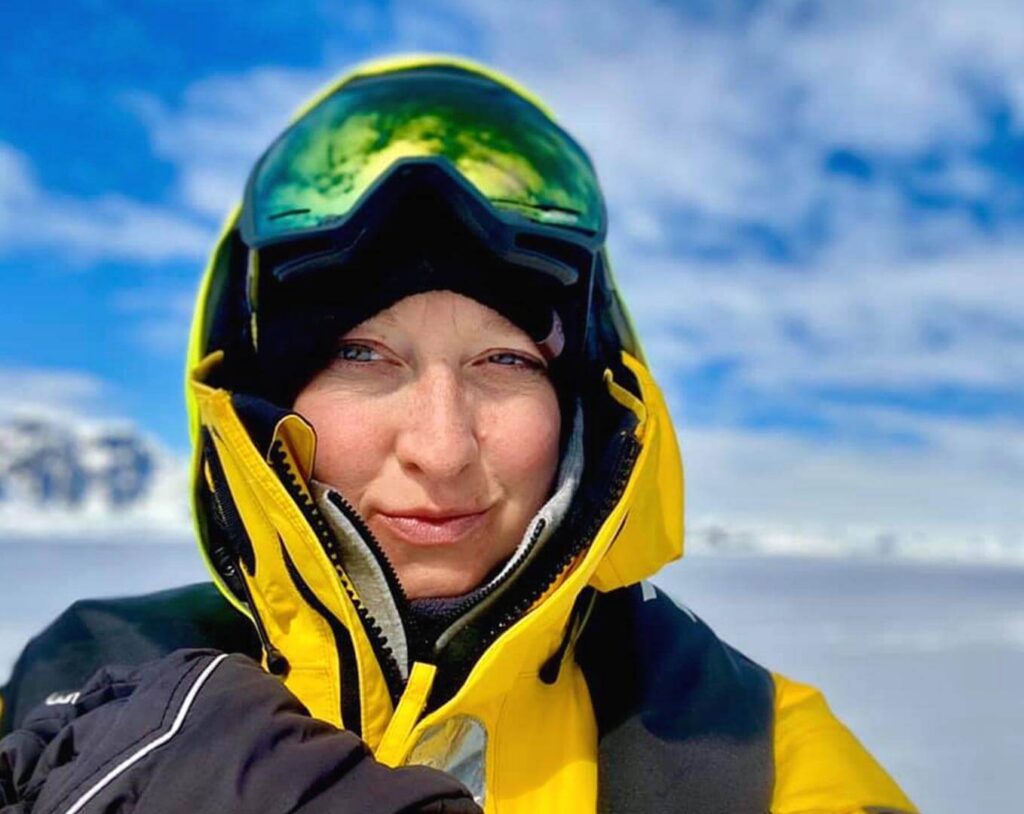
Uryupova grew up in Siberia. She holds a Ph.D. in Environmental Sciences from Lomonosov Moscow State University and a master’s in international journalism from the University of Salford.
That pairing is unusual and useful. Her background spans marine biology and oceanography; she has interned at the Secretariat of the Antarctic Treaty in Argentina and at the Smithsonian Institution, and she has worked in both Antarctica and the Arctic for over 10 years.
Her first visit to Antarctica came in 2008, and she has spent the years since finding ways back, first through scientific projects and stations, then aboard expedition yachts. She told Recommend that she came to prefer fieldwork because it let her see change happening up close and explain it to people in plain terms.1
She is one of three expedition leaders across the polar fleet. Jonathan Zaccaria leads aboard World Navigator® and Didier Drouet aboard World Voyager®.
Protecting the Place You Came to See
Part of the job is restraint. An expedition leader decides how close is close enough, how fast a Zodiac approaches wildlife, and when the right answer is to turn around.
Uryupova points to the specifics, including speed limits in well-protected areas, careful Zodiac speed near wildlife, and managing light at night so seabirds are not blinded. She also notes that the Antarctic season runs from November to March, leaving the rest of the year for the environment to recover.1
On select Antarctica expeditions, you can take part in that work yourself. An ocean conservationist from ORCA, a whale and dolphin conservancy, leads hands-on workshops where you learn to gather data, record sightings, and photograph what you see as a citizen scientist. On others, conservationists from the Global Penguin Society invite you to join them as they track and record information that helps protect penguin populations.
Those practices sit inside a wider framework. Atlas is a member of IAATO and AECO, the associations that set operating standards for Antarctic and Arctic tourism, and the line’s environmental commitments are gathered under Conscious Navigation.
What This Looks Like From Where You Stand
On a larger vessel, decisions like these may happen out of view. On a yacht with fewer than 200 guests, you’ll likely see the expedition leader at breakfast. They are in the Zodiac. They are the person explaining, at the moment it happens, why today’s landing moved.
That access changes the texture of the trip. Included Zodiac excursions and shore landings put you alongside the team rather than behind it, and the Polar Plunge comes with fellow explorers cheering you on. In Antarctica, optional sea kayaking and, when conditions allow, overnight camping go further still.
Uryupova has said she wants to grow in other people the passion she found on that first trip in 2008.1 That is the real answer to what a polar expedition leader does. The logistics are the mechanism. The point is that you leave understanding where you have been.
See a Polar Day for Yourself with Atlas Ocean Voyages
Explore Atlas’ Antarctica and Arctic cruises, or see the yachts that make this kind of day possible.
Contact us to start planning your luxury Polar voyage.
Frequently Asked Questions
What does a polar expedition leader actually do each day?
The expedition leader decides where the day goes. Before most guests are awake, they read the overnight ice, wind, and sea conditions, talk the plan through with the captain, choose a landing site that is safe and appropriate for wildlife, and assign the specialists who will run each excursion. They also decide when to change it, including partway through a landing that is going well.
How many people are on an Atlas expedition team?
Every Antarctica and Arctic expedition is led by a team of up to 17 specialists. It typically includes kayak guides, naturalists, marine biologists, ornithologists, climatologists, photographers, mountaineering experts, and specialists in history and conservation.
Will I get to spend time with the expedition team?
Yes. On a yacht carrying fewer than 200 guests, the team is present throughout the day rather than behind a counter. Guides lead Zodiac excursions and shore landings, run the Polar Plunge, and accompany optional kayaking and camping outings, if conditions allow. Meals, lectures, and Après Expedition in the lounges put you in the same social spaces as the people making the day happen.
When is the Antarctic expedition season?
Uryupova notes that the season runs from November to March, which leaves the rest of the year for the environment to recover.1 Some sailings depart in late October. Conditions shift across those months, and she adds that from late October to late February, guests experience near round-the-clock daylight, while March brings milder conditions and the return of dark skies for stargazing.1
Do I need polar experience to join an expedition?
No. The expedition team handles the technical judgment, gives daily briefings, and adjusts activities to the group. Guides instruct you on how to move around wildlife at a safe distance and what each landing involves before you step into a Zodiac.
References
1. Paloma Villaverde de Rico, “In Conversation with an Antarctic Expedition Leader,” Recommend, May 7, 2026, https://recommend.com/featured/in-conversation-with-an-antarctic-expedition-leader/.